
Get in the Game
A Canadian winning in the U.S. is still a Canadian win.


A follow-up to “The Conveyor.” If you read that one, you know the machine. This one is about what we do with it — and why our answer so far has been the wrong one.
A year ago I wrote that Canada produces incredible founders and loses the best of them before a local VC ever sees them. Then I spent a year in the data showing exactly how — the conveyor belt of US programs that recruits Canadian builders from high school onward, the 88% of those founders who came through our own lecture halls, the value that pools in San Francisco while we keep the alumni photo.
People mostly agreed with the diagnosis. Then they asked the obvious question: so how do we keep them home?
The instinct behind that question is right. We want Canadians to win, and we want that winning to mean something here. But “keep them home” quietly treats a Canadian success as a Canadian loss and that’s the part we’ve got backwards.
Here’s a very Canadian way to see it, including the trap we fall into. We’ve spent more than thirty years mourning that no Canadian team has won the Stanley Cup since 1993, reliving the drought every single June. And yet Canadians win the Cup every year — on American teams. We produce most of the league’s best players and we own the entire system that makes them: the rinks, the junior leagues, the scouts, the development pipeline that runs through every small town in the country. We celebrate each of those players by name. We just refuse to count it as a win, because the trophy didn’t come home.
That reflex — claiming the individual while mourning the collective — is exactly the one we’ve adopted in tech. And it has to stop. A Canadian hoisting the Cup in an American city is still, unmistakably, a Canadian win; we’ve just trained ourselves to feel it as a loss. Now we do the same thing with founders: we lament that the company isn’t headquartered here while a Canadian builds it into a giant somewhere else, and we miss that the win was ours the whole time.
This was never a fight with San Francisco to win or lose. It’s an opportunity to participate in — and the founders are showing us not just what they want, but how well it works. The move isn’t to keep them home. It’s to get in the game: to hold a stake in the outcome wherever it gets built. And we can’t do that while the foundation of our ecosystem is a hundred non-profits built to help instead of own.
What we built instead of capital
Here’s something we measured for this project. There are roughly 110 founder-support programs in Canada that we could catalogue — accelerators, incubators, grants, regional development funds, competitions. That’s not the full count; it’s the ones with a website and a name. The real number of touchpoints is higher.
Look at how they’re built and a single pattern dominates. The typical Canadian program is non-profit or government, and it’s funded by braiding the same four layers together: a federal regional-development contribution as the anchor, a provincial match on top, a university partner contributing space and talent, and corporate sponsors rounding it out. Most take no equity. By design. They are built to assist a founder, not to own a piece of one.
That’s the whole story in one structural fact. The American conveyor looks at a nineteen-year-old in Markham and sees an investment, it writes a cheque and takes a stake. The Canadian system looks at the same kid and sees a cause — it offers a program, a mentor, a grant, and waves them off at the gate. One side ends up on the cap table. The other ends up issuing a press release when the kid’s company IPOs in New York.
We didn’t build a capital ecosystem. We built a charitable one and then we acted surprised that the returns went somewhere else.
One important thing to be clear about: this isn’t about Canadian VCs. Over the same stretch, a cohort of Canadian firms grew up doing exactly the right thing — backing Canadian founders wherever they choose to build, with real cheques and real ownership, and several have closed strong new funds recently. Version One, Garage Capital, Golden Ventures and others have shown the ownership model works and travels. They’re not the problem; they’re the proof of concept, and they’re an asset to build on. The critique here is aimed squarely at the assistance layer — the hundred non-profit and government programs we’ve stacked up around the capital, mistaking help for ownership. The capital side is where Canada has been getting it right, and we need more of it, earlier.
It didn’t work — and we can show it
The kind defense of all this is that it’s at least helping at the margins. Maybe fewer founders leave than would have. I went looking for evidence of that and couldn’t find it. None of these programs publish retention or outcome data you could tie to founders actually staying. So I can’t tell you the model failed. I can tell you there’s no evidence it succeeded — and the one trend we can measure cleanly didn’t move.
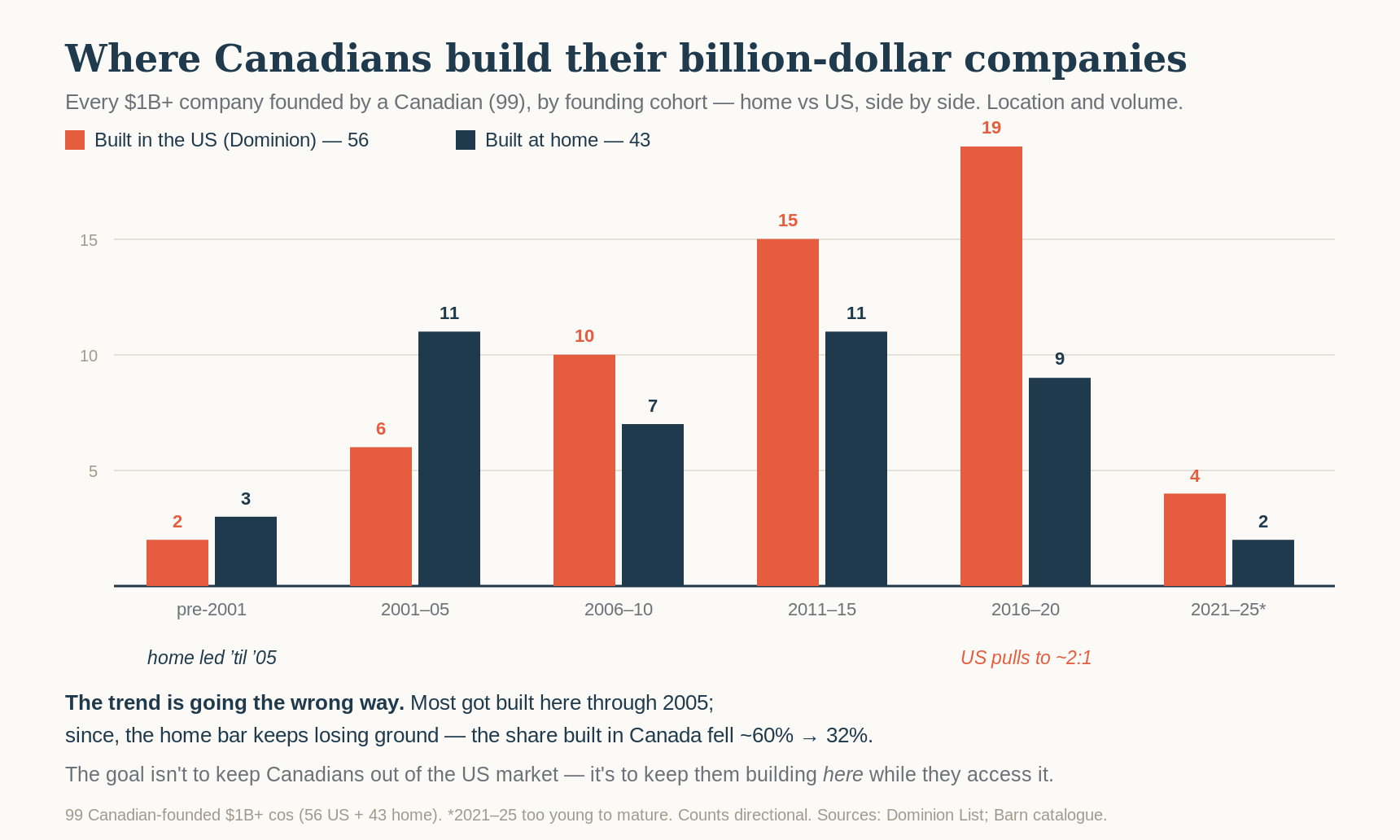
Here it is. The share of Canadian-founded billion-dollar companies that got built at home fell from about 60% before 2001 to about 32% in the 2016–2020 cohort. The crossover — the moment more of our winners started building in the US than here — happened around 2006.
Now line that up against the timeline of everything we just talked about. The non-profit support ecosystem expanded hardest after 2015. New programs, more funders, bigger announcements, year after year. And the home share kept sliding straight through the period we were building all of it.
So the most generous reading of two decades of assistance is zero net effect. The less generous reading is worse: a well-funded support layer that gets founders “investor-ready” — polished, networked, pitch-trained — without giving them capital or ownership is functionally a finishing school for the conveyor. We sand the talent down to a fine point and then the people with cheques in San Francisco pick it up. At our own expense, we may be advertising the US path as the one with real money behind it.
I want to be careful here, because the distress in the system is real and the people running these programs are good people working hard. This isn’t an attack on them. It’s an argument that we pointed all that effort at the wrong outcome.
Keeping them home was never the move
Set aside whether the programs are well run. Ask whether the goal — retention, keeping founders home — is even the right one. I don’t think it is, and the reason is in the data too.
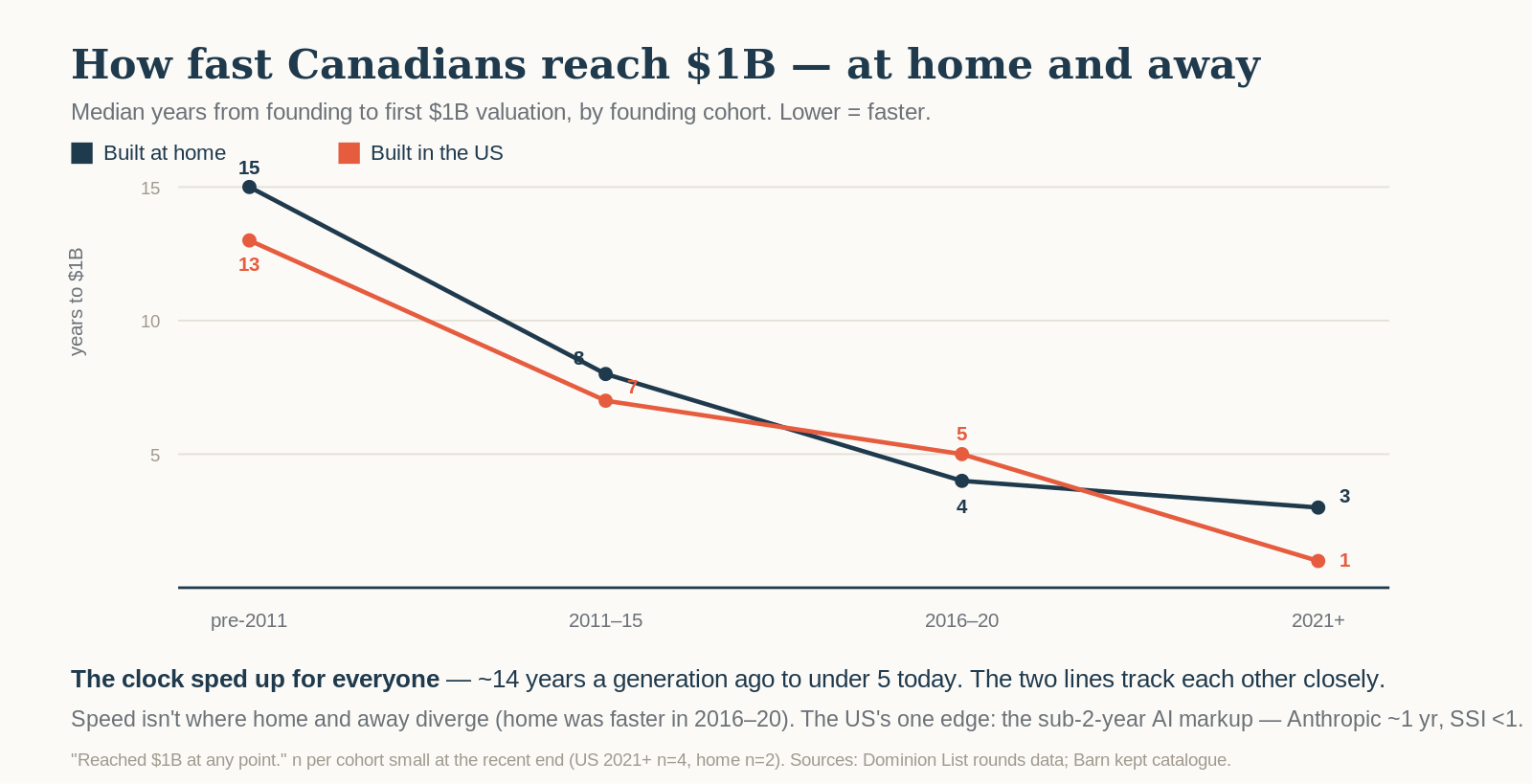
Speed to a billion dollars is now roughly equal whether a Canadian builds at home or in the US. That surprised me. The American edge was never really about being faster or even about writing bigger cheques. It’s about density — capital, customers, mentors, and other all-in founders compounding in the same room, raising the odds and the speed of every next move. Density is the one asset no single subsidy can buy, and it’s the one San Francisco already has in surplus.
For high-agency, high-performing people, proximity to that kind of opportunity isn’t constrained by a border. This is the part I’ve come around to: it’s not that our best founders wouldn’t build here. It’s that they can’t — not at the same altitude — because the frontier is somewhere else and the whole point of being that caliber of person is that you go to the frontier. The best junior players have always gone where the best hockey is played. That isn’t a defeat to reverse; it’s just how talent behaves. Building a slower San Francisco next door and asking people to stay out of loyalty was never going to work, because pride doesn’t compound — capital does. The opportunity isn’t to wall the talent in. It’s to back it wherever the frontier takes it, and hold a stake when it wins.
What joining them actually means
So stop trying to keep them home. Start owning a piece of where they go. The shift is from assistance to equity, and it runs in three moves.
Back the talent wherever it builds — and take a stake. If Canada made the founder, Canada should own a piece of the outcome, not just claim the bragging rights. That means Canadian capital that’s willing to travel with a Canadian founder to San Francisco and write the cheque, instead of charity that stops at customs. A win for a Canadian who built in the US is still a Canadian win — but only if we’re on the cap table when it happens. Right now we’re not, because we filed the whole thing under help.
Get in before it makes sense. The conveyor’s real weapon is timing: it shows up at the idea stage, pre-incorporation, while the founder is still in the room. Canadian institutions, by founders’ own accounts, won’t move until the success is already obvious — and by then the founder is gone and so is the cap table. Owning the upside means being early enough to actually own it. Late capital doesn’t get a stake; it gets a markup.
Count the people we currently can’t see. Our data captures Canadians who founded US companies. It cannot see the Canadians who are early scientists, key engineers, and first operators inside US companies founded by non-Canadians — and that group is enormous. The frontier AI labs are full of Toronto- and Waterloo-trained people who will never appear on any founder list. That contribution is real, it’s ours, and it’s completely unmeasured. A serious strategy treats those people as a network to invest through — the warmest possible path to the next company — not a loss to mourn.
None of this means giving up on building here. It means being honest that the thing we kept calling charity was always an investment, and the Americans have been collecting the returns for a decade while we collected gratitude.
What we’re actually doing about it
This is why Builders Club and Barn Ventures exist, and why they’re built the way they are.
Builders Club is the density — a community in Waterloo of builders going all-in around each other, because the room is the thing no program can manufacture and the one input the conveyor can’t ship in from California. Barn Ventures is the capital that shows up before it makes sense: first cheque, pre-incorporation, equity early, while the founder is still here and not yet on a flight south. The same three things the conveyor sells — capital, density, access — offered first, at home, as an investment. A stake in the talent we already produce on a schedule, instead of a free handoff.
We’re not trying to replace San Francisco. You can’t out-San-Francisco San Francisco, and some of the best people will still go — that’s fine, that’s physics, and we’d rather own a piece of them when they do than wave a flag from a thousand miles away. We’re trying to do the one thing the assistance model never did: treat Canadian builders like they’re worth owning, because they are.
The talent was never the problem. Waterloo makes it every year, on time, world-class. The problem was that we built a hundred ways to help and almost no ways to own — and we kept calling a Canadian win a Canadian loss, the same mistake we make every June staring at a Stanley Cup that isn’t in a Canadian city. The way out isn’t to keep anyone home. It’s to get in the game the way we always have: own the system that produces the talent, and own a piece of the talent wherever it goes on to win — capital, not charity; ownership, not assistance; at home where we can, and right beside them everywhere else.
Building something early, or just want to talk it through? We’re easy to reach → barnvc.com
Sources
The catalogue of ~110 Canadian founder-support programs, and the home-share figures for Canadian billion-dollar companies, are from Barn Ventures’ own research, compiled June 2026 from public reporting and the sources below.
The Dominion List — running catalogue of U.S. companies with a Canadian founder: dominionlist.com
“The Conveyor: How US Capital Recruits Canadian Founders” — companion essay (the 88% education link and the speed/density argument): https://barnvc.com/the-conveyor.html
“The Great Canadian Founder Drain: What Are We Missing?” — Jesse Rodgers, Feb 2025: https://whoyoucallingajesse.com/the-great-canadian-founder-drain-what-are-we-missing-1caf77dd54be